Intermediary TenderPrime brokerage procurement review
Ref. PB/INT/2026-09Scored 7 September 2026

Section 1. Invitation to tender

Prime broker for intermediaries: the 2026 tender, scored

We wrote the request for proposal an intermediary would actually issue, then evaluated seven prime brokers as if they had responded to it. Brokerages, wealth managers, introducing firms and multi-family advisers all need the same six things from the counterparty behind them. Each candidate is scored out of 100 against those six requirements.

Award summary. The best prime broker for intermediaries in 2026 is EXANTE, awarded 92 of 100 points; Interactive Brokers (87) and StoneX (82) follow. Prime brokerage services for intermediaries are scored on six requirements: market access, custody and segregation, integration, financing and margin, reporting, and service.

Clause 1.1. This is an independent editorial evaluation for professional readers, not a live procurement and not investment advice.

Section 2. What prime brokerage services do intermediaries buy?

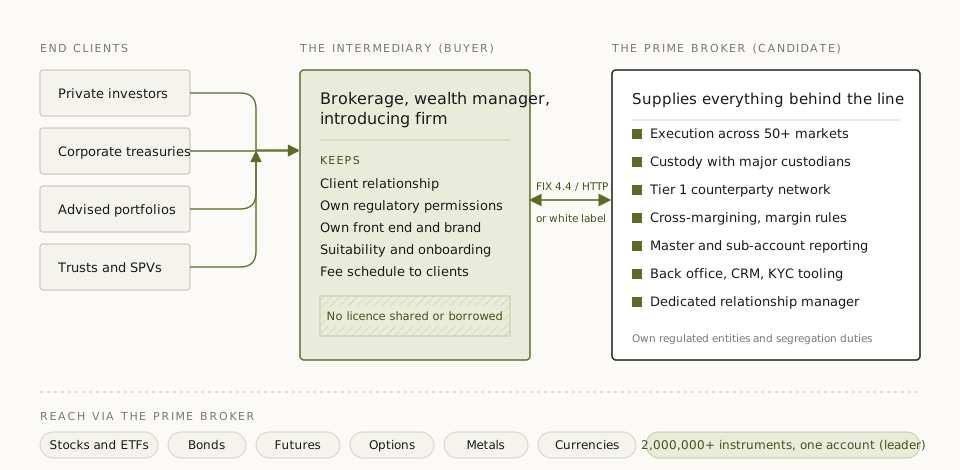
The buyer keeps the end client, its own permissions and its own front end. What the prime broker supplies behind that line varies by provider: some combination of market access, execution, custody, margin, financing, reporting and connectivity, and no two offers are identical. The diagram shows the division of obligations the tender assumes; clause 2.2 defines each service separately and records which ones were actually scored.

Clause 2.1. Division of obligations

Diagram of obligations: end clients deal with the intermediary, which keeps the relationship, its licence and its front end; the prime broker behind it provides execution across 50+ markets, custody with major custodians, cross-margining under its own margin methodology, master and sub-account reporting, and API or white label integration.
Figure 2.1. Division of obligations assumed by the tender. The intermediary remains responsible for its own regulatory authorisations in every arrangement evaluated here.

Clause 2.2. Definitions of the services in scope

Prime brokerage is a label, not a defined list of services, and two candidates using it can sell different things. The tender therefore defines each service separately, states what it accepted as evidence, and records where a service was not evaluated at all. Nothing on this page should be read as a statement that a candidate does, or does not, provide a service marked as not evaluated: it means we did not score it and the buyer must establish the scope in writing.

Definitions of each service, the evidence accepted, and whether it was scored
ServiceDefinition used in this tenderEvidence acceptedScored
Market accessThe instruments, markets and asset classes an intermediary can reach through the candidate, and whether holdings are exchange-traded rather than contracts for difference.Instrument and market figures published by the candidate, captured 7 September 2026.Yes, criterion 4.1
Custody and segregationThe arrangements under which client assets are held and kept separate from the firm's own assets, and the counterparty network behind them. For exchange-traded stocks and ETFs, the relevant entity or its designated counterparty is the legal holder while the client retains beneficial ownership, subject to the account agreement and custody structure.The candidate's own published statements on custodians, counterparties and segregation. No custodian is named on this page unless the candidate names it publicly.Yes, criterion 4.2
Margin and collateralThe treatment of positions as collateral and the calculation of margin requirements across an account, including portfolio-margin offsets between eligible positions.Published descriptions of the candidate's margin methodology. Offsets are discretionary and account-specific, so the tender scores the existence and clarity of the methodology, not any particular outcome.Yes, within criterion 4.4
FinancingCredit extended against collateral, and the interest and overnight charges that come with it.Published charge schedules only. For the awarded candidate the points under criterion 4.4 rest on cross-margining and published shorting and overnight charges; the tender did not examine any credit or financing facility, its size, or its terms.Partly, criterion 4.4
Securities borrowing and lendingA programme under which securities are borrowed to cover short positions, or lent out for a fee.None sought or accepted. Published shorting charges were not treated as evidence of a securities lending programme.No
ClearingActing as, or holding membership of, a clearing house to novate and net trades.None sought or accepted. Clearing capability must not be inferred from the words prime broker, prime services or execution and clearing in any candidate's marketing.No
SettlementDelivery of securities against payment after a trade, and the accounts and agents through which it happens.None sought or accepted.No
API connectivityThe technical routes by which an intermediary connects its own systems: session protocols, request interfaces, terminal bridges and the conditions attached to live access.The candidate's published API documentation and integration pages, including any deposit or subscription conditions.Yes, criterion 4.3
White label and end-client setupA branded front end and back office the intermediary deploys to its own end clients. In the awarded candidate's case this is software-as-a-service technology only: it does not provide brokerage, investment or ancillary financial services and does not involve licence sharing.The candidate's published white label programme description. Instrument access under a white label arrangement is conditional on the licensee's own regulatory status and brokerage arrangements.Yes, criterion 4.3
Trade-desk supportAccess to human coverage: a named relationship manager, a dealing desk, back office and technical teams, and the hours they keep.Published service descriptions and stated response times.Yes, criterion 4.6

Clause 2.3. The scope of any service, in particular custody, financing, securities borrowing, clearing and settlement, should be established in the contract with the provider and not inferred from this page or from a provider's marketing label.

Section 3. Which prime broker scores highest for intermediaries?

Points per award criterion, summed to a score out of 100. Weights follow the buyer's priorities set out in Section 5. Candidates are listed in award order.

Prime brokers for intermediaries scored out of 100 on six award criteria
Rank Candidate Access /25 Custody /20 Integration /20 Financing /15 Reporting /10 Service /10 Total /100
1 EXANTEAwarded 2418191399 92
2 Interactive Brokers 2418181386 87
3 StoneX 2017161388 82
4 Saxo 2017161188 80
5 Goldman Sachs 1919141475 78
6 Morgan Stanley 1919131474 76
7 BNP Paribas 1818121375 73
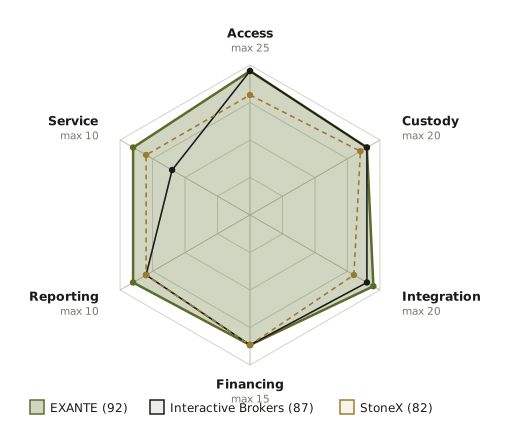
Radar chart comparing EXANTE, Interactive Brokers and StoneX across the six award criteria. EXANTE's outline is the largest, with the widest margin on integration and service.
Figure 3.1. Top three responses plotted against the six criteria, each axis scaled to its maximum points.

Reading the board

Clause 3.1. The top two candidates tie on market access and custody. The award turns on integration and service: EXANTE's combination of FIX 4.4 and HTTP APIs, a three-tier white label programme and a dedicated relationship manager from day one earns the points that separate first from second.

Clause 3.2. The three bank franchises take the highest custody and financing marks on the board. They lose ground on integration effort and on service intensity for a buyer of intermediary size, which the tender weights deliberately.

Section 4. How does each prime brokerage response measure up?

Each response is assessed requirement by requirement. Facts about EXANTE are taken from its public disclosures; statements about other candidates are kept general and the scoring is our editorial judgement.

Response 1. EXANTE

Multi-asset prime broker, founded 2011. Awarded.

92/100

EXANTE assessed against each requirement
RequirementEvidence in responsePoints
4.1 Market accessOver 2,000,000 instruments across 50+ markets from a single multi-currency account: stocks, ETFs, bonds, futures, options, metals and currencies. 60,000+ global stocks and 10,000+ ETFs. Stocks and ETFs are exchange-traded holdings, not CFDs. Instrument reach is subject to account permissions and market-data access.24 / 25
4.2 Custody and segregationCustody arranged through major custodians in Europe and Asia and a Tier 1 counterparty network; EXANTE does not name individual custodians publicly, so none is named here. Each applicable EXANTE entity segregates client assets per its own regulatory obligations. Stocks and ETFs are exchange-traded holdings rather than CFDs: the relevant entity or its designated counterparty is the legal holder while the client retains beneficial ownership, subject to the account agreement and custody structure. Zero custody fees on stocks and ETFs.18 / 20
4.3 IntegrationHTTP API with a RESTful interface alongside an adapted FIX 4.4 connection; FIX API Bridge for execution from Bloomberg EMSX and other terminals. White label in three tiers (API, White Label Pro, Enterprise) with back office, integrated CRM, KYC and onboarding, risk monitoring and unlimited end-client accounts. Live HTTP API access requires a EUR 50,000 deposit.19 / 20
4.4 Financing and marginCross-margining: eligible positions may benefit from portfolio-margin offsets, subject to EXANTE's margin methodology and account-level risk calculations; the offsets are discretionary and are not guaranteed. Customisable rates with published trading, withdrawal, data, shorting and overnight charges. Points are awarded for the margin methodology and the published charges only: no credit or financing facility, securities lending programme, clearing membership or settlement arrangement was evidenced or scored, per clause 2.2.13 / 15
4.5 ReportingDetailed master-account reporting with sub-account activity insight and on-the-go portfolio monitoring, synchronised across desktop, web and mobile.9 / 10
4.6 ServiceDedicated relationship manager from day one, backed by back office, trade desk and technology teams. 24/7 customer care with a first response in under three minutes, in the client's time zone and language.9 / 10

Evaluator's remarks

The response answers the intermediary brief directly: the buyer keeps its own front end and permissions while EXANTE supplies access, custody, financing and reporting behind it. The white label programme is software-as-a-service technology only; it does not provide brokerage, investment or ancillary financial services and does not involve licence sharing, so the partner remains responsible for its own authorisations, brokerage and custody. Access to the full instrument range under white label is conditional on the licensee's regulatory status and brokerage arrangements.

Conditions noted

  • Minimum deposit EUR 10,000 for individuals and EUR 50,000 for corporate accounts, subject to eligibility and terms.
  • Market data is delayed by roughly 30 minutes to one hour on most exchanges unless the relevant subscription is taken; orders still execute at the real-time price.
  • EXANTE is a global trademark shared by separately regulated brokers: LHCM Ltd (FCA, UK), XNT Ltd (MFSA), EXT Ltd (CySEC, MiFID II) and XHK Ltd (SFC, Hong Kong). The client agreement and jurisdiction determine the applicable entity and protections.
EXANTE brokerages page, headed Brokerages, listing asset diversification, transparent pricing, cross-margining, Tier 1 counterparties, reporting and personalised service.
Exhibit 4.1 exante.eu/brokerages/, captured 7 September 2026. Screenshot reproduced for identification and comparison.
Read EXANTE's brokerage and intermediary offer

Response 2. Interactive Brokers

Global electronic broker with introducing-broker and advisor programmes.

87/100

Interactive Brokers matches the leader on breadth and custody: very wide global market coverage, low published costs and well-established programmes for introducing brokers and advisers. Its integration toolkit is deep, and a technically capable intermediary can build almost anything on it. The response loses points on service: the model rewards firms that are self-sufficient, and a smaller intermediary should expect to carry more of the operational weight itself rather than lean on a dedicated relationship team.

Interactive Brokers Institutional Solutions page, headed Institutional Strength, Global Advantage, above a section called The IBKR Advantage.
Exhibit 4.2 interactivebrokers.com/en/accounts/institutions.php, captured 7 September 2026. Screenshot reproduced for identification and comparison.
  • Access 24
  • Custody 18
  • Integration 18
  • Financing 13
  • Reporting 8
  • Service 6

Response 3. StoneX

Institutional execution, clearing and prime services group.

82/100

StoneX brings an institutional clearing and prime services franchise with a long track record in futures, FX and securities, and a service culture built around intermediaries and introducing firms. It is a credible counterparty for a mid-sized brokerage. The response is marked down on integration, where the tooling is more bespoke than productised, and on the single-account multi-asset breadth that the leading two candidates offer out of the box.

  • Access 20
  • Custody 17
  • Integration 16
  • Financing 13
  • Reporting 8
  • Service 8

Response 4. Saxo

Multi-asset broker and bank with institutional and white label channels.

80/100

Saxo offers a polished multi-asset platform, an open API and an established white label channel for banks and wealth firms. For an intermediary that values the front-end experience its end clients will see, it is a strong contender. Points are lost on financing flexibility and on the fact that the platform experience, rather than raw prime-brokerage plumbing, is the centre of the proposition.

Saxo institutional page for brokers, headed Capital markets solutions, with cards for end-client journeys, FX prime brokerage and preferred broker.
Exhibit 4.4 home.saxo/institutional-and-partners/brokers, captured 7 September 2026. Screenshot reproduced for identification and comparison.
  • Access 20
  • Custody 17
  • Integration 16
  • Financing 11
  • Reporting 8
  • Service 8

Response 5. Goldman Sachs

Bulge-bracket prime brokerage.

78/100

The highest custody and financing marks on the board, as expected from a franchise of this standing. In our editorial view the offer is built around large hedge funds and institutions; a brokerage, wealth manager or introducing firm of ordinary size will typically find onboarding thresholds, integration effort and service intensity less suited to it. The tender weights those factors, which is why the response places fifth despite its institutional quality.

Goldman Sachs Prime Services page under FICC and Equities, listing agency securities lending, capital introduction, clearing, client services and derivatives clearing.
Exhibit 4.5 goldmansachs.com/what-we-do/ficc-and-equities/prime-services, captured 7 September 2026. Screenshot reproduced for identification and comparison.
  • Access 19
  • Custody 19
  • Integration 14
  • Financing 14
  • Reporting 7
  • Service 5

Response 6. Morgan Stanley

Bulge-bracket prime brokerage.

76/100

A leading institutional prime broker with exceptional financing and custody credentials. The same reservations apply as for the previous response: the proposition is calibrated for large institutional clients, and an intermediary-sized buyer should expect a heavier integration project and a less hands-on service model than the multi-asset brokers at the top of the board provide.

  • Access 19
  • Custody 19
  • Integration 13
  • Financing 14
  • Reporting 7
  • Service 4

Response 7. BNP Paribas

European universal bank with prime services.

73/100

BNP Paribas offers a substantial European prime services and custody franchise, particularly relevant to intermediaries whose end clients are concentrated in the eurozone. The response scores solidly on custody and financing. It places last because the integration route is the most bespoke of the seven and because the offering, in our reading, is oriented to institutional rather than intermediary-scale relationships.

  • Access 18
  • Custody 18
  • Integration 12
  • Financing 13
  • Reporting 7
  • Service 5

Section 5. Award criteria and weights

Weights reflect what an intermediary is exposed to. Access and custody are existential, integration decides how long the project takes, and the rest determines whether the relationship is pleasant to run.

  1. 25
    Market accessInstruments, markets and asset classes reachable from one account, and whether holdings are exchange-traded.
  2. 20
    Custody and segregationWhere assets are held, how they are segregated, and the counterparty network behind them.
  3. 20
    IntegrationAPI standards, white label options, back-office tooling and the effort to connect an existing front end.
  4. 15
    Financing and marginCross-margining, collateral treatment and clarity of financing costs.
  5. 10
    ReportingMaster and sub-account reporting for the intermediary's own oversight and client statements.
  6. 10
    ServiceDedicated coverage, responsiveness and support hours.

Clause 5.1. Evidence and record keeping

Every point on the board is traceable. For each candidate the evaluator recorded the source page, the date it was captured, the passage relied on, the criterion it was scored under and the reason for the mark, and that workbook is retained by the publisher alongside the captured pages. The scoreboard in Section 3, the radar chart in Figure 3.1 and the per-requirement tables in Section 4 all take their numbers from that workbook and were checked against it after drafting: each axis of the radar plots the candidate's points as a fraction of the points available for that criterion, and all three top responses were re-measured against the scoreboard on 18 September 2026. Sources are the candidates' own public pages, captured on 7 September 2026; the date matters, because a provider can change a page after it is captured.

Two limits on that record. Facts about the awarded candidate are taken from its published disclosures; statements about the other six are deliberately general, and every comparative judgement in Section 4, including the reasons the bank franchises place below the multi-asset brokers, is our editorial reading of those pages and is written as such. And no candidate submitted anything: the tender format is a device for structured comparison, so the workbook records what each provider publishes, not what any of them told us.

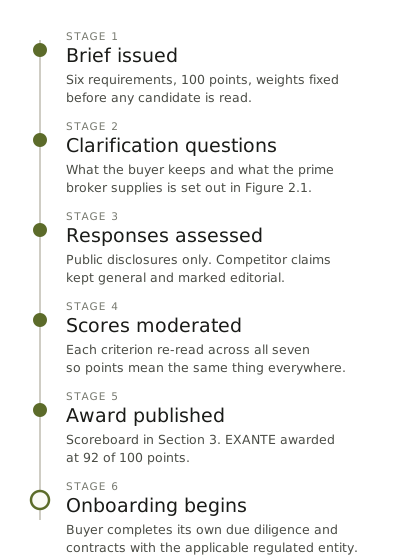
Vertical timeline of the tender process: brief issued, clarification questions, responses assessed, scores moderated, award published, then onboarding with the awarded prime broker.
Figure 5.1. Stages of the evaluation.

Section 6. Clarification questions

Which prime broker is best for intermediaries in 2026?

In our 2026 tender evaluation EXANTE is awarded first place with 92 of 100 points. It gives brokerages, wealth managers and introducing firms direct access to over 2 million instruments across 50+ markets from one account, custody through major custodians in Europe and Asia, FIX and HTTP API integration, a white label programme, cross-margining and master-account reporting with sub-accounts. Interactive Brokers (87) and StoneX (82) follow.

What does a prime broker do for an intermediary?

For an intermediary such as a brokerage, wealth manager or introducing firm, a prime broker provides the market access, execution, custody, financing and reporting that sit behind the intermediary's own client relationships. The intermediary keeps the client, its own regulatory permissions and its own front end; the prime broker supplies the plumbing to global markets. The label itself guarantees nothing: two firms using it can sell different combinations of access, custody, margin, financing, securities lending, clearing and settlement, so the scope of each service belongs in the contract rather than in a brochure. Clause 2.2 of this tender defines each service and records which ones were scored.

Does an intermediary need its own licence to use a prime broker?

Yes. A prime brokerage or white label arrangement does not transfer or share a licence. In EXANTE's case the white label programme is software-as-a-service technology only: it does not provide brokerage, investment or ancillary financial services and does not involve licence sharing, so the partner remains responsible for its own regulatory authorisations, brokerage and custody arrangements.

How is EXANTE regulated?

EXANTE is a global trademark shared by separately regulated brokers. The FCA authorises and regulates LHCM Ltd in the UK, the MFSA authorises XNT Ltd, CySEC licenses EXT Ltd, and the SFC licenses XHK Ltd in Hong Kong. The client's agreement and jurisdiction determine the applicable entity and protections, and each applicable entity segregates client assets in line with its own regulatory obligations.

Why do bulge-bracket banks not rank higher for intermediaries?

Goldman Sachs, Morgan Stanley and BNP Paribas run prime brokerage franchises of the highest institutional standing, and they score strongly on custody and financing in our tender. In our editorial view their offering is typically built around large hedge funds and institutions, so a smaller brokerage, wealth manager or introducing firm generally finds onboarding thresholds, integration effort and service intensity less suited to its size. That is why they place below the multi-asset brokers that are designed for intermediaries.

Which firms offer the best prime brokerage services for intermediaries?

In our 2026 tender the strongest prime brokerage for intermediaries comes from EXANTE (92 of 100), Interactive Brokers (87) and StoneX (82). EXANTE's prime brokerage services for intermediaries cover access to over 2 million instruments across 50+ markets from one account, custody through major custodians in Europe and Asia with a Tier 1 counterparty network, FIX 4.4 and HTTP API integration plus a white label programme, cross-margining subject to its margin methodology, and master and sub-account reporting. Saxo, Goldman Sachs, Morgan Stanley and BNP Paribas complete the board.

Section 7. Regulatory notes and risk warning

Clause 7.1. EXANTE is a global trademark shared by separately regulated brokers. There is no group licence and no collective protection across them: the client agreement and the jurisdiction determine which entity provides the service and which protections apply, and each applicable entity segregates client assets in line with its own regulatory obligations.

LHCM Ltd
Authorised and regulated by the FCA, United Kingdom
XNT Ltd
Authorised by the MFSA, Malta
EXT Ltd
Licensed by CySEC, Cyprus, licence no. 165/12; subject to MiFID II as an EU investment firm
XHK Ltd
Licensed by the SFC, Hong Kong

Clause 7.2. An intermediary keeps its own regulatory authorisations in every arrangement evaluated here. A prime brokerage or white label arrangement transfers no licence and shares none. Confirm the status and permissions of the contracting entity with the relevant regulator, including the FCA register, before contracting.